Delivery Tech WatchTechnologies

← All technologies · Zipline profile

Zipline delivery technology

Zipline built two platforms. Platform 1 (P1) is a catapult-launched fixed-wing plane that drops packages by parachute, in a first generation from 2016 and a faster second from 2018. Platform 2 (P2), in US commercial service from April 2025, hovers about 300 ft up and lowers a steerable "droid" on a line to a spot about a meter across.

Delivery capacity

Small, about one meal or a small parcel

Up to 8 lb/3.6 kg on newest model, or 4 lb/1.75 kg on older drone model.

Vehicles

Platform 2 (P2) Zip and droid

DroneIn serviceAnnounced March 15, 2023 · April 2025 – now

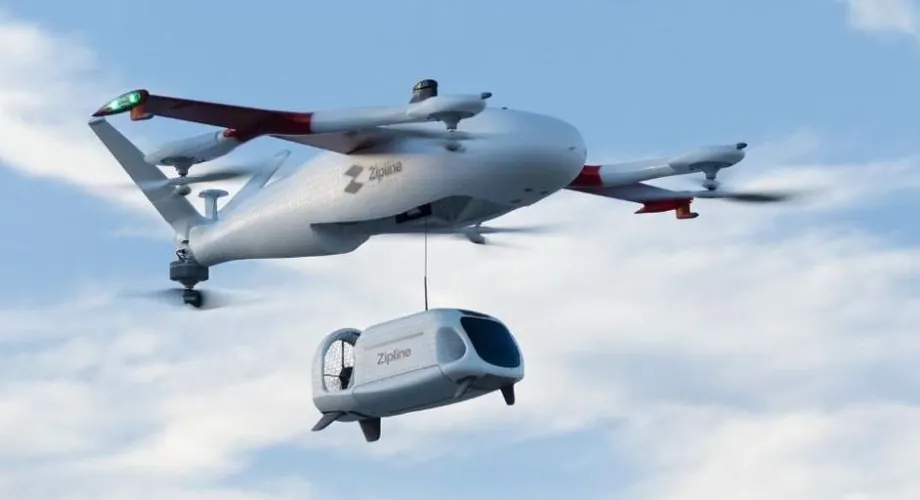
A hovering, fixed-wing drone (the Zip) with 5 propellers that stays about 300 ft up and lowers a self-steering droid on a line, replacing P1's parachute drop with deliveries to a small spot.

A render of a Zipline P2 Zip in the sky: a white fuselage with Zipline lettering, red-tipped wings and white rotor booms, lowering a white droid on a line beneath it.
Render: Zipline [1].
Platform 2 (P2) Zip and droid specifications
PayloadUp to 8 lb (3.6 kg); 6 to 8 lb at its 2023 launch [2][3][4]
Empty weightAbout 55 lb (25 kg) aircraft; under 63 lb (29 kg) with the maximum payload [2]
DimensionsAbout 7.8 ft (2.4 m) wingspan, 8 ft (2.4 m) long, 1.8 ft (0.55 m) tall [2]
SensorsKinds not published; the droid senses what is below to touch down on the chosen spot [5]
Propulsion5 propellers; the tail propellers tilt 90° between lift and forward flight; fixed wings for cruise; slow-turning propellers with uneven blade spacing; lithium-ion batteries [1][2][6]
DeliveryHovers at least 300 ft (90 m) up and lowers the droid on a winch line; the droid steers itself with its own thrusters to a spot about 1 m (3 ft) across [1][2][7]
Range10 mi (16 km) service radius, or 24 mi (39 km) one way dock to dock [8]
Top speedUp to 70 mph (113 km/h) per Zipline, and cruising at 70 mph in the FAA's 2026 Arizona assessment; 47 mph (76 km/h) en route in its 2025 Dallas–Fort Worth assessment [2][5][6]
ManufacturingBuilt by Zipline in South San Francisco, California; the plant is being tripled to make up to 15,000 aircraft a year (September 2025) [9]
UnknownCargo space and compute
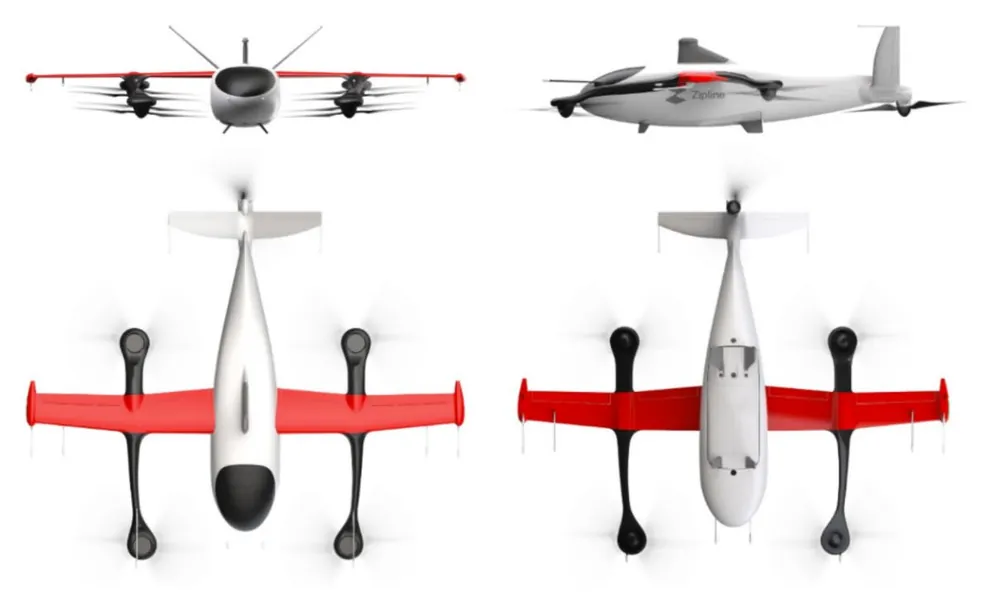
Renders of the P2 Zip from the front, the side, above and below: red wings, a white fuselage and two black booms, with its wingspan and five propellers marked on the top view.
Front, side, top and bottom views. Render: Zipline (in an FAA environmental assessment) [2]. Labels added by Delivery Tech Watch from [2]. Labeled: Wingspan about 7.8 ft (2.4 m) and 5 propellers.
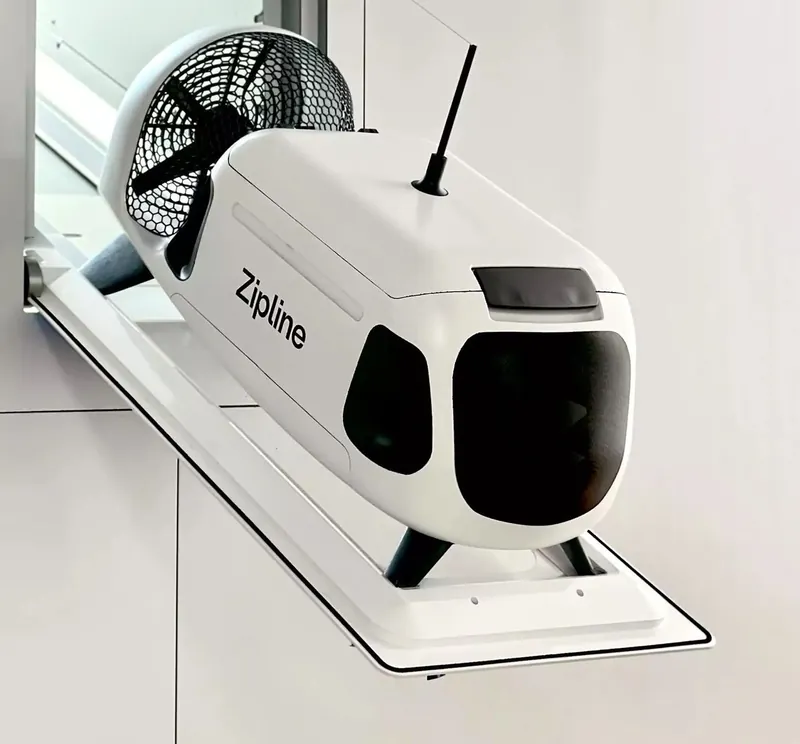
The white Zipline droid, a rounded pod with a fan at the back, two dark windows at the front and an antenna, resting in a wall-mounted loading port.
The droid, docked in a loading port. Render: Zipline [3].

Design points

Make the package steer itself. A box winched from a hovering drone blew around even under 10 m, and steerable parachutes might not come back. With a droid that steers, the Zip "doesn't even need to see the package" and can stay high, which helps noise, safety and energy. [7]

Propellers tuned to sound like a fan. Slow-turning propellers push sound into lower frequencies that fade with distance, and uneven blade spacing avoids a single tone, so the aircraft sounds "closer to … a fan" than a buzz. [1]

Platform 1 (P1), second-generation Zip

DroneIn serviceAnnounced April 3, 2018 · 2018 – now

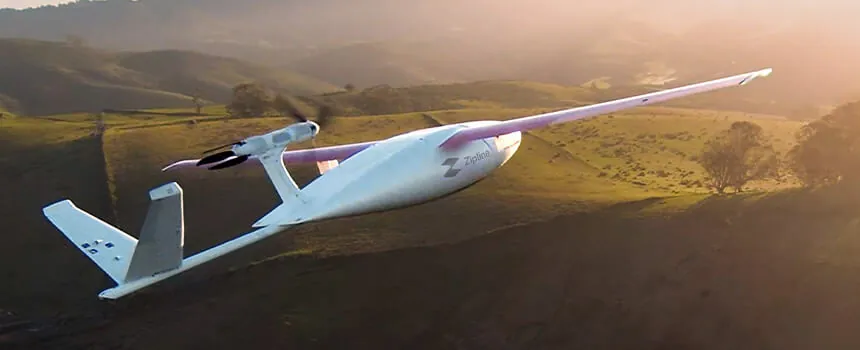
The faster, easier-to-maintain P1 redesign of April 2018: a catapult-launched fixed-wing plane that drops packages by parachute and is caught by a hook on a wire.

A white Zipline P1 Zip flying low over green hills at sunset: a long slender wing, a pylon above the fuselage with two propellers, and a tail on a thin boom.
Photo: Zipline [5].
Platform 1 (P1), second-generation Zip specifications
PayloadUp to 3.9 lb (1.75 kg) in 2018, later about 4 lb (1.8 kg); 3.5 lb (1.6 kg) in the FAA's 2022 Salt Lake City filing [10][11][12][13]
Empty weight49.3 lb (22.4 kg) maximum take-off weight per the FAA; about 44 lb (20 kg) per Wikipedia [13][14]
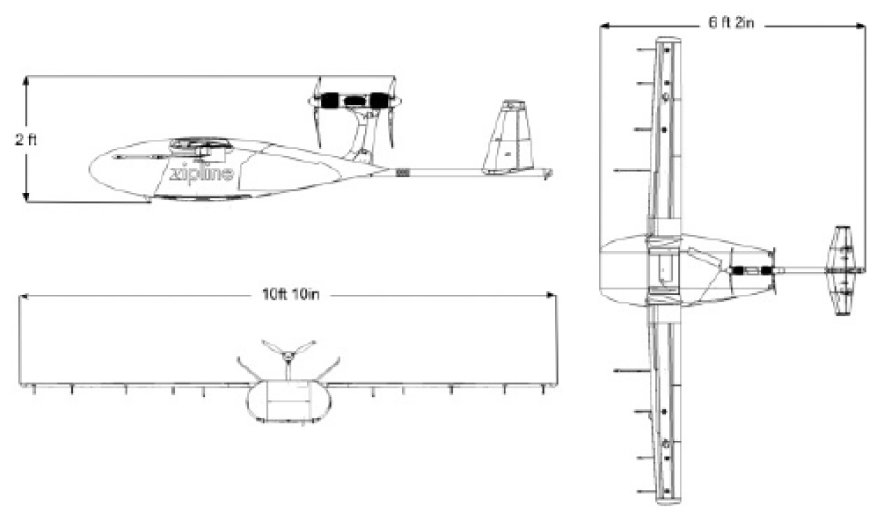
Dimensions10 ft 10 in (3.30 m) wingspan, 6 ft 2 in (1.88 m) fuselage length, 2 ft (0.61 m) tall [13]
PropulsionTwo electric motors on a pylon above the fuselage, turning three-bladed propellers; launched by catapult, caught by a wire capture line [13][14]
DeliveryDrops the package by parachute into a zone about 16 ft (5 m) across ("about two parking spaces") [7][14]
RangeUp to 100 mi (160 km) round trip in 2018; up to 155 mi round trip per Zipline's site [5][10]
Top speedTop speed 80 mph (128 km/h); cruises about 63 mph (101 km/h); the catapult reaches 67 mph (108 km/h) in 0.33 s [10][14]
UnknownCargo space, sensors, compute, and manufacturing
Line drawings of the P1 Zip from the side, front and above, with its height, wingspan and length.
Side, front and top views. Diagram: Zipline (in an FAA environmental assessment) [13]. Labels added by Delivery Tech Watch from [13]. Labeled: 2 ft (0.61 m), 10 ft 10 in (3.30 m), and 6 ft 2 in (1.88 m).
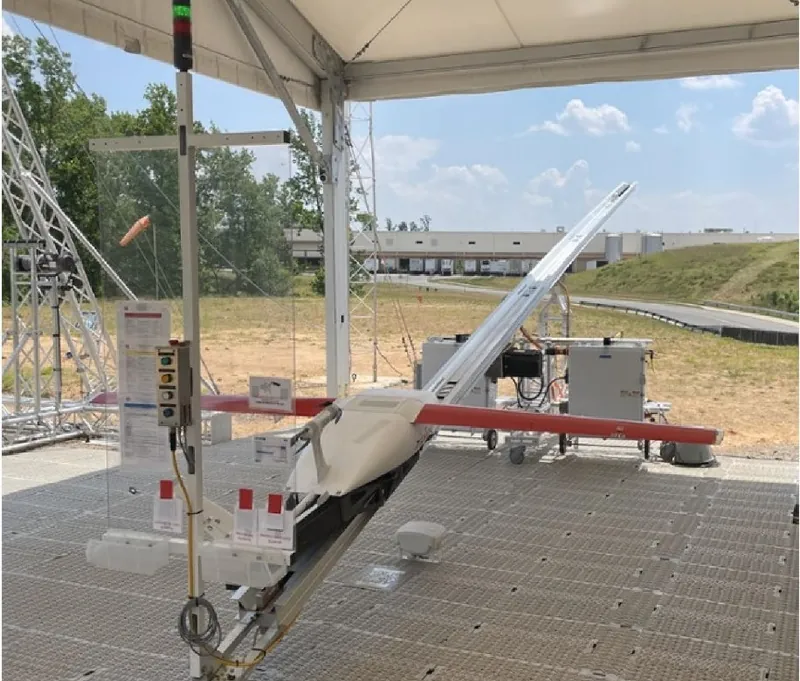
A P1 Zip with red wings mounted on an inclined catapult launcher under a tent canopy.
On its launcher at the Salt Lake City-area site. Photo: Zipline (in an FAA environmental assessment) [13].

Design points

Speed matters most. "The biggest thing we learned [in Africa] is that speed is everything" (CEO Keller Rinaudo Cliffton). The 2018 redesign cut order-to-launch time from 10 minutes to one and made the aircraft easier to maintain, with computer vision helping pre-flight inspections. [10]

Platform 1 (P1), first-generation Zip

DroneRetiredOctober 2016 – 2018

The first Zip, a fixed-wing medical delivery drone that began service in Muhanga, Rwanda in October 2016; no detailed specifications were published.

Platform 1 (P1), first-generation Zip specifications
UnknownCargo space, payload, empty weight, dimensions, sensors, compute, propulsion, delivery, range, top speed, and manufacturing

Milestones

Sources

17

Each source lists what on this page it supports. See the methodology for how sources are classified.

Pictures belong to those credited under them and are shown to identify and compare the vehicles; they are not covered by the data license.

  1. Zipline’s Never-Ending Quest to Make Quiet Deliveries Even Quieter ↗, Zipline, March 25, 2026 Official
    Images: Platform 2 (P2) Zip and droid Vehicles: Platform 2 (P2) Zip and droid (propulsion; delivery) Design points: Platform 2 (P2) Zip and droid (Propellers tuned to sound like a fan)
    “We recently raised our typical flying altitude to at least 300 feet … Zipline aircraft take off and land vertically using their five propellers … We also use uneven blade spacing”
  2. Final Environmental Assessment for Zipline International Inc. proposed operations, Dallas–Fort Worth ↗, Federal Aviation Administration, December 23, 2025 Official
    Vehicles: Platform 2 (P2) Zip and droid (payload; empty weight; dimensions; propulsion; delivery; top speed) Images: Platform 2 (P2) Zip and droid Image labels: Platform 2 (P2) Zip and droid Milestones: December 23, 2025
    “wingspan of approximately 7.8 feet, a height of approximately 1.8 feet … multi-rotor design with 5 propellers … The maximum noise exposure levels are associated with dock operations, where DNL 65 dB occurs within 70 feet of a dock perimeter and DNL 60 dB occurs within 150 feet.”
  3. Zipline unveils autonomous system for quiet, fast, and precise home delivery ↗, Zipline, March 15, 2023 Official
    Vehicles: Platform 2 (P2) Zip and droid (payload) Images: Platform 2 (P2) Zip and droid
    “its fully autonomous delivery droid maneuvers down a tether, steers to the correct location, and gently drops off its package … Each P2 Zip has a 10-mile service radius while carrying a 6-8 pound payload”
  4. Zipline completes first customer delivery with P2 drone ↗, DroneXL, January 16, 2025 News
    Vehicles: Platform 2 (P2) Zip and droid (payload)
  5. Autonomous Delivery Technology ↗, Zipline, accessed November 2026 Official
    Vehicles: Platform 2 (P2) Zip and droid (sensors; top speed); Platform 1 (P1), second-generation Zip (range) Images: Platform 1 (P1), second-generation Zip
    “Each Zipline flies up to 70 mph on a direct path … The pod senses what’s below and touches down exactly where you want. … Drones can fly up to 155 miles roundtrip on a single charge.”
  6. Draft Environmental Assessment for Zipline International Inc. Proposed Drone Package Delivery Operations in Multiple Arizona Metropolitan Areas ↗, Federal Aviation Administration, November 2026 Official
    Vehicles: Platform 2 (P2) Zip and droid (propulsion; top speed)
    “Tail propellers tilt on a 90 degree axis”
  7. How Zipline Designed Its Droid Delivery System ↗, IEEE Spectrum (Evan Ackerman), March 15, 2024 News
    Vehicles: Platform 2 (P2) Zip and droid (delivery); Platform 1 (P1), second-generation Zip (delivery) Design points: Platform 2 (P2) Zip and droid (Make the package steer itself)
    “Platform 1 can deliver within an area of about two parking spaces … So we deleted all that code, and now it just comes straight down”
  8. Zipline Unveils New Autonomous System Capable of Quiet, Fast and Precise Home Delivery ↗, Zipline release via Business Wire, March 15, 2023 Official
    Vehicles: Platform 2 (P2) Zip and droid (range)
    “Each P2 Zip has a 10-mile service radius … practically silent (designed to sound like wind rustling leaves)”
  9. Zipline to Triple U.S. Manufacturing Facility, Creating More Jobs in AI and Robotics ↗, Zipline, September 30, 2025 Official
    Vehicles: Platform 2 (P2) Zip and droid (manufacturing)
    “The company will triple its existing South San Francisco, CA facility … The expansion is designed to enable Zipline to produce up to 15,000 autonomous aircraft per year”
  10. Zipline launches the world's fastest commercial delivery drone ↗, MIT Technology Review, April 3, 2018 News
    Vehicles: Platform 1 (P1), second-generation Zip (payload; range; top speed) Design points: Platform 1 (P1), second-generation Zip (Speed matters most)
    “a load of up to 1.75 kilograms on a round trip of up to 160 kilometers”
  11. Zipline reveals home drone delivery platform ↗, DroneLife, March 16, 2023 News
    Vehicles: Platform 1 (P1), second-generation Zip (payload)
  12. Reevaluation of the Final Environmental Assessment and FONSI/ROD: Zipline International Inc. Drone Package Delivery Operations in Pea Ridge, Arkansas ↗, Federal Aviation Administration, February 20, 2026 Official
    Vehicles: Platform 1 (P1), second-generation Zip (payload)
    “including a maximum payload of approximately 4 pounds”
  13. Final Environmental Assessment for Zipline International Inc. package delivery operations in Salt Lake City, Utah, and the surrounding area ↗, Federal Aviation Administration, December 2022 Official
    Vehicles: Platform 1 (P1), second-generation Zip (payload; empty weight; dimensions; propulsion) Images: Platform 1 (P1), second-generation Zip Image labels: Platform 1 (P1), second-generation Zip
    “The UA has a maximum takeoff weight of 49.3 pounds, including a maximum payload of 3.5 pounds. … The wingspan is 10 feet, 10 inches, with a fuselage length of 6 feet, 2 inches.”
  14. Zipline (drone delivery company) ↗, Wikipedia (secondary; cites WSJ, Wired, IEEE Spectrum, FAA), accessed November 2026 Other
    Vehicles: Platform 1 (P1), second-generation Zip (empty weight; propulsion; delivery; top speed) Milestones: January 2026
    “forward flight lift only”
  15. Report to Congress: Operations of Unmanned Aircraft Systems Deliveries (Public Law 117-103) ↗, Federal Aviation Administration, May 22, 2023 Official
    Milestones: June 17, 2022
    “On June 17, 2022, Zipline became the fourth drone operator”
  16. Zipline Receives FAA Part 135 Air Carrier Certification to Grow Its Automated, On-Demand Delivery Service in the U.S. ↗, Zipline, June 21, 2022 Official
    Milestones: June 17, 2022
    “This is the first part 135 certification issued under the FAA’s BEYOND program”
  17. FAA Authorizes Zipline International, Inc. to Deliver Commercial Packages Using Drones That Fly Beyond Operator's Line of Sight ↗, Federal Aviation Administration, September 18, 2023 Official
    Milestones: September 18, 2023
    “Zipline will use its Sparrow drone to release the payload via parachute.”

Seen a specification or a model we're missing? Reach out.