Delivery Tech WatchTechnologies

← All technologies · Starship profile

Starship delivery technology

Starship has kept one small six-wheeled design since its 2015 prototype (named '6C' on its About page; '6E' followed in 2017) and changed it mostly on the inside: the computer moved from an NVIDIA Tegra K1 to an AMD Ryzen system with an FPGA, and the sensors grew to twelve cameras plus radar and ultrasonics. Starship does not publish a numbered list of generations; a third-party catalog's "Gen 4" label cites no company source.

Delivery capacity

Medium, a few bags of groceries

Up to 20 lb/9.1 kg or 'three shopping bags.'

Vehicles

Current robot

Wheeled robotIn service

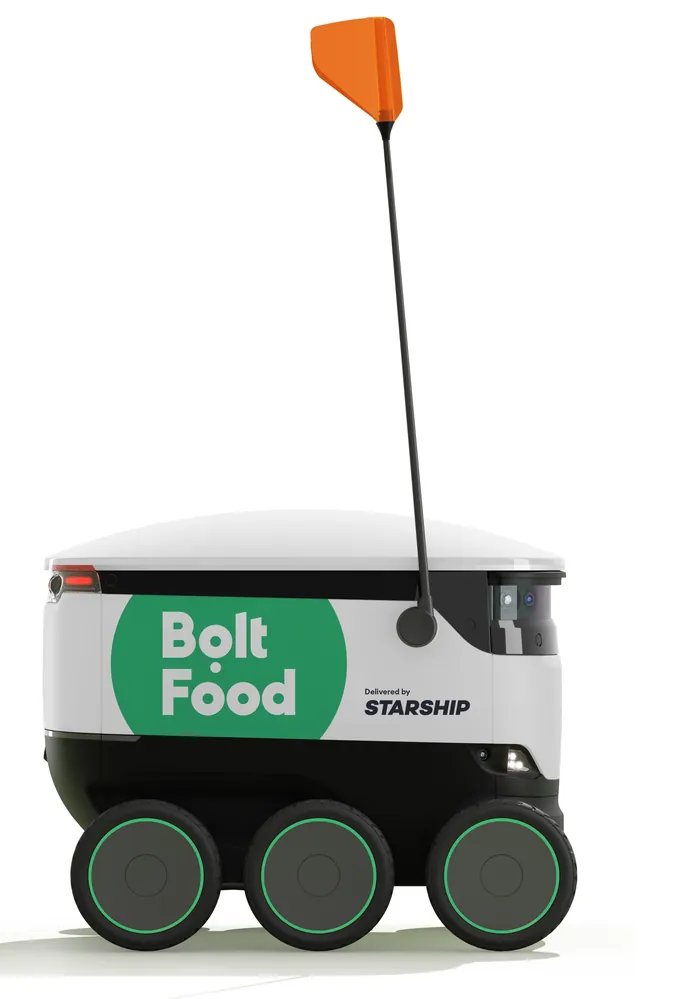
Starship's robot in service today: the same six-wheeled body as the early robots, with an AMD Ryzen computer, 12 cameras, radar and an 18-hour battery.

Side view of a Starship robot in Bolt Food livery: a white body with a domed white lid, a black lower body on six wheels, a front camera panel and an orange flag on a tall pole.
Render: Starship Technologies [1]. Labels added by Delivery Tech Watch from [2]. Labeled: About 22 in (55 cm).
Current robot specifications
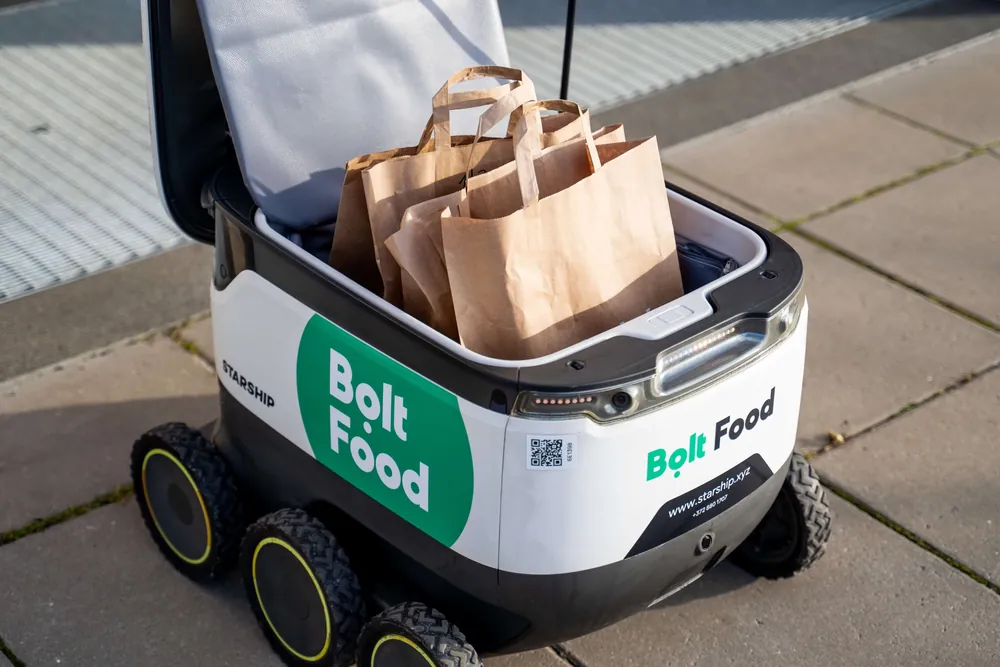
Cargo spaceInsulated compartment for up to three shopping bags, kept hot, cold or frozen [3]
PayloadUp to 20 lb (9.1 kg); the company said "10 kg" in 2025 [3][4][5]
Empty weightAbout 83 lb (38 kg) without cargo per Starship's FAQ; about 77 lb (35 kg) per the European Investment Bank (2022); 55 lb (25 kg) per Wikipedia [2][4][6]
DimensionsAbout 22 in (55 cm) tall, plus the flag [2]
Sensors12 cameras including time-of-flight, radars and ultrasonic sensors [3][6]
ComputeAMD Ryzen computer plus an FPGA for time-critical signal processing [7]
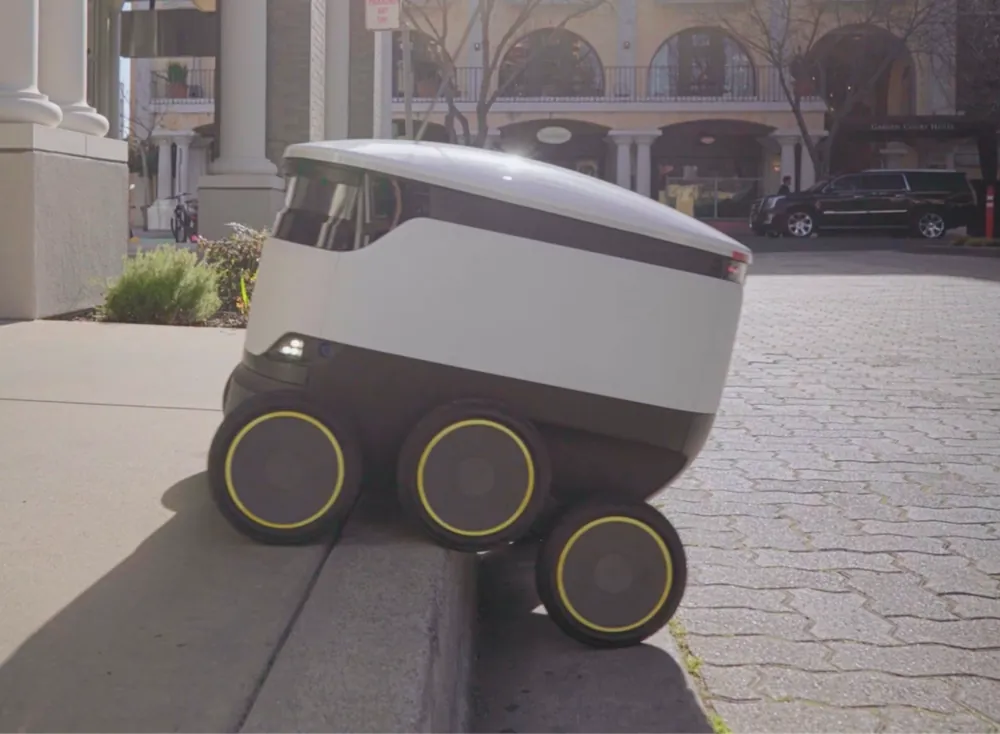
WheelsSix wheels on a bogie system that climbs and dismounts curbs; winter wheels for snow [3][6]
Battery and range18 hours on one charge; wireless charging overnight on site [3]
Top speedAbout 4 mph (6.4 km/h), walking pace [3][6]
UnknownManufacturing
A Starship robot with its lid open and three paper shopping bags inside the insulated compartment.
Cargo. Photo: Starship Technologies (photo: Liisa-Ingrid Kerson) [3]. Labels added by Delivery Tech Watch from [3]. Labeled: Insulated compartment: up to 3 shopping bags.
A Starship robot climbing a curb from the street onto a sidewalk, its front wheels raised on the bogie.
Climbing a curb. Photo: Starship Technologies [3].

Design points

Safety runs on the robot. The robots handle "all critical safety functions locally - even if the internet connection drops". Network latency is why time-critical signal processing runs on an onboard FPGA rather than in the cloud. [3][7]

Curbs without ramps. Six wheels on a bogie let the robot climb up and down curbs on its own rather than needing curb ramps; winter wheels are fitted for snow. [3][6]

Pilot and early commercial robot (2016 to 2019)

Wheeled robotRetired2016 – 2019

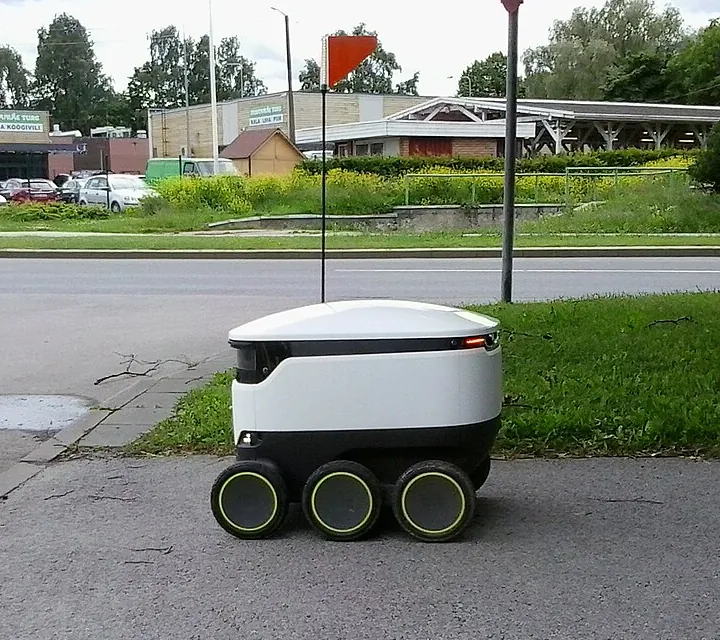
The robot of Starship's 2016 pilots and first commercial services, through the first US campus fleet in 2019: the prototype's six-wheel design with an NVIDIA Tegra K1 computer and cameras that look only up to knee height.

A Starship robot with a white body, black lower body, six wheels with yellow rims and an orange flag on a pole, on a sidewalk beside a road.
June 2017. Photo: Mardus, CC BY-SA 4.0 (Wikimedia Commons) [8].
Pilot and early commercial robot (2016 to 2019) specifications
Payload20 lb (9.1 kg) [9]
Empty weight55 lb (25 kg) with the flagpole (a 2017 unit) [9]
Dimensions27.4 × 22.4 × 22.5 in (697 × 569 × 571 mm) long, wide and tall; 46.7 in (1,187 mm) tall with the flag [9]
SensorsCameras looking only up to knee height, GPS and ultrasonic sensors; 10 cameras per the CTO in 2018 [9][10]
ComputeNVIDIA Tegra K1 (a 2014 mobile chip) [7]
WheelsSix wheels; the two rear pairs change height to lift the robot onto curbs [9]
Top speed3.7 mph (6 km/h) [9]
UnknownCargo space, battery and range, and manufacturing

Design points

Low unit cost. Research robots carry sensor packages "upwards of $10,000", which "simply won't work in the delivery space". Starship ran its image processing on a lower-end computer and calibrated most sensors automatically. [10]

Cameras look only to knee height. For the privacy of customers and passers-by, the cameras only look up to knee height as the robot navigates. [9]

Prototype (2015)

Wheeled robotRetiredAnnounced November 2, 2015 · 2015 – 2016

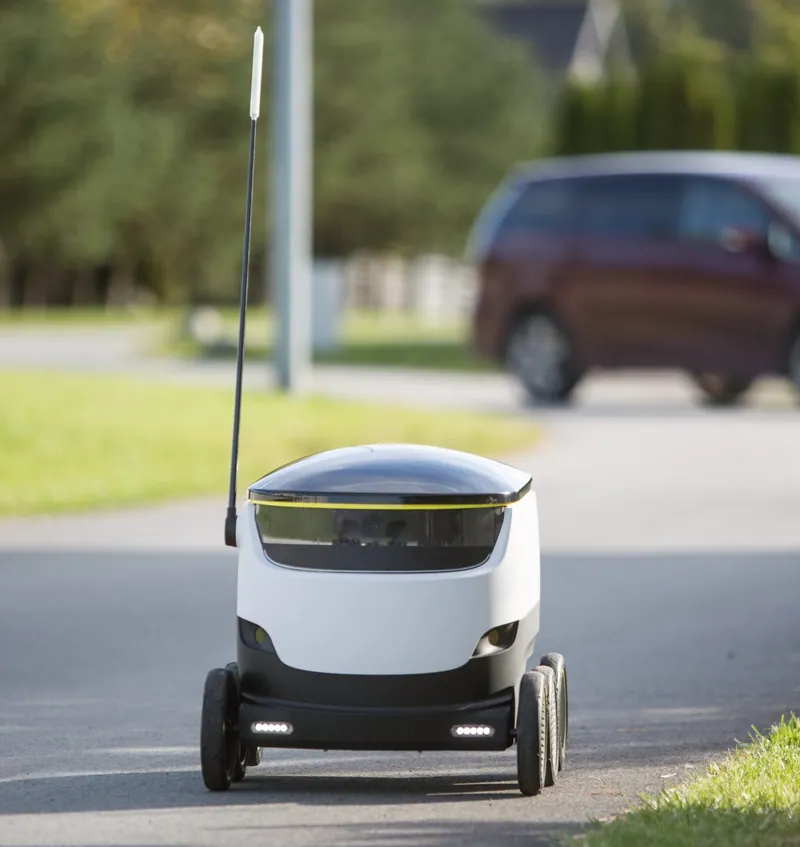
The first public Starship robot, shown in November 2015 (Starship's About page calls its 2015 robot '6C'): a small six-wheeler that finds its way with cameras because GPS isn't accurate enough on sidewalks.

An early Starship robot on a paved path: a white body with a dark domed lid, a yellow stripe, a camera band at the front, six small wheels and a thin antenna pole without a flag. Starship's About page shows it for 2015.
Shown for 2015 on Starship's timeline. Photo: Starship Technologies [11].
Prototype (2015) specifications
PayloadAbout 22 lb (10 kg), two grocery bags [12]
SensorsCameras for vision-based navigation, with speakers and microphones for remote telepresence [12]
WheelsSix wheels; climbs curbs [12]
Top speedWalking pace [12]
UnknownCargo space, empty weight, dimensions, compute, battery and range, and manufacturing
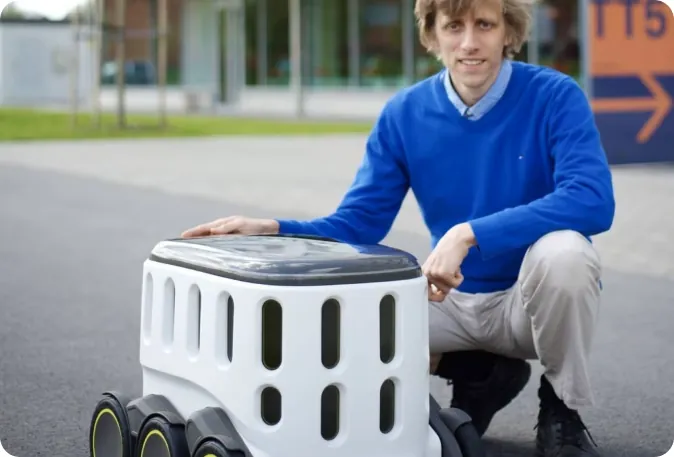
Co-founder Ahti Heinla crouching beside a rough first prototype: a white slotted box body on black wheels.
The first prototype, 2014. Photo: Starship Technologies [11].

Design points

Light and slow is safe. A small robot makes it "difficult for the machine to accidentally hurt anyone", and it can "safely stop and wait indefinitely for a human to step in" (IEEE Spectrum's analysis). [12]

Maps instead of GPS. GPS is not accurate enough on sidewalks, so robots locate themselves to about 2 cm in a 3D map of building edges, poles and rooftops that they help build and that must be kept up to date. [10][13]

Milestones

Sources

16

Each source lists what on this page it supports. See the methodology for how sources are classified.

Pictures belong to those credited under them and are shown to identify and compare the vehicles; they are not covered by the data license.

  1. Press ↗, Starship Technologies, accessed November 2026 Official
    Images: Current robot
    “Search past announcements, or download our press kit and latest release.”
    The robot render is from the press kit's Robot images download.
  2. Robotics: Starship delivery ↗, European Investment Bank, September 9, 2022 Official
    Image labels: Current robot Vehicles: Current robot (empty weight; dimensions)
    “Thanks to their twelve cameras and six wheels … They might be 55 centimeters tall and weigh around 35 kilograms”
  3. Our robots ↗, Starship Technologies, accessed November 2026 Official
    Vehicles: Current robot (cargo space; payload; sensors; wheels; battery and range; top speed) Images: Current robot Image labels: Current robot Design points: Current robot (Safety runs on the robot; Curbs without ramps)
    “12 cameras, including time-of-flight … the speed of a walking pedestrian … carry up to three shopping bags, with an insulated interior … 18 hours on a single charge … Six wheels and a bogie system enable them to dismount and climb curbs … handling all critical safety functions locally - even if the internet connection drops”
  4. Starship Technologies ↗, Wikipedia (secondary), accessed November 2026 Other
    Vehicles: Current robot (payload; empty weight) Milestones: January 2019
    “They weigh 55 pounds (25kg) unloaded, and can carry up to 20 pounds (9.1kg) of deliveries.”
  5. Starship Technologies obtains Series C for autonomous deliveries across the U.S. ↗, The Robot Report, October 2025 News
    Vehicles: Current robot (payload)
    “the number of seconds per kilometer where a human's involved”
  6. FAQ ↗, Starship Technologies, accessed November 2026 Official
    Vehicles: Current robot (empty weight; sensors; wheels; top speed) Design points: Current robot (Curbs without ramps)
    “The robots are low mass (approx. 38kg / 83 lbs. without cargo), low speed (~4 mph/6.4kmh) … equipped with twelve cameras, a sensor suite, radar, time-of-flight (TOF) capabilities … the robots’ 6 wheel design and bogie system allows them to go up and down curbs”
  7. Running autonomous robots on city streets is very much a software engineering challenge ↗, Starship Technologies (Medium), 2020 Official
    Vehicles: Current robot (compute); Pilot and early commercial robot (2016 to 2019) (compute) Design points: Current robot (Safety runs on the robot)
    “Tegra TK1 in older robots and AMD Ryzen based system in newers”
  8. Delivery rover by starship.xyz, June 2017.jpg ↗, Wikimedia Commons, June 27, 2017 Other
    Images: Pilot and early commercial robot (2016 to 2019)
    “Photo: Mardus Rover: starship.xyz”
  9. Starship Technologies self-driving delivery robot (object 2026-27) ↗, Science Museum Group, accessed November 2026 Official
    Vehicles: Pilot and early commercial robot (2016 to 2019) (payload; empty weight; dimensions; sensors; wheels; top speed) Design points: Pilot and early commercial robot (2016 to 2019) (Cameras look only to knee height)
    “Made: 2017 … (6kmph or 3.7mph) … can hold up to 9.1kg of goods. The two rear pairs of wheels on the robot are height adjustable … the robot’s cameras only ‘look’ up to knee height … Measurements: (h) 1187 w/o flagpole 571mm (w) 569mm (l) 697mm Flag height 831mm, weight with flagpole 25kg”
  10. Hello, Robot! ↗, Starship Technologies (Medium, Ahti Heinla), 2018 Official
    Vehicles: Pilot and early commercial robot (2016 to 2019) (sensors) Design points: Pilot and early commercial robot (2016 to 2019) (Low unit cost); Prototype (2015) (Maps instead of GPS)
    “The robot has a siren and 10 cameras, it is constantly connected to Internet and knows its precise location with an accuracy of 2cm”
  11. About ↗, Starship Technologies, accessed November 2026 Official
    Images: Prototype (2015)
    “the first prototype of a delivery robot is created in August. 2015 We stealth-launched the world’s first delivery robot, modestly named ‘6C’ … Model ‘6E’ is released.”
    Images are those shown with the 2014 and 2015 entries of the page's timeline.
  12. Starship Technologies' autonomous ground delivery robots ↗, IEEE Spectrum, November 2, 2015 News
    Vehicles: Prototype (2015) (payload; sensors; wheels; top speed) Design points: Prototype (2015) (Light and slow is safe)
    “fully loaded weighs less than 20 kg … GPS isn't accurate enough to keep these robots on sidewalks”
  13. How Starship Delivery Robots know where they are going ↗, Starship Technologies (Medium, Joan Lääne) Official
    Design points: Prototype (2015) (Maps instead of GPS)
    “Keeping maps up to date is crucial to keep the robots driving safely and autonomously.”
  14. Starship Technologies Raises $50M Series C ↗, Starship Technologies, October 15, 2025 Official
    Milestones: October 15, 2025
    “2,700+ robots operating across 270+ locations in seven countries … Operating at Level 4 autonomy”
  15. Starship Technologies and Uber Eats Launch Autonomous Delivery Partnership ↗, Business Wire (company release), November 20, 2025 Official
    Milestones: November 20, 2025
    “collectively completing 100,000+ road crossings every day. This extensive real-world experience has generated a dataset of approximately 200 million crossings”
  16. Starship Technologies moves 1,200 campus robots to grocery delivery ↗, Fox News, July 6, 2026 News
    Milestones: July 2026
    “keep service running through the 2026–2027 back-to-school season”

Seen a specification or a model we're missing? Reach out.