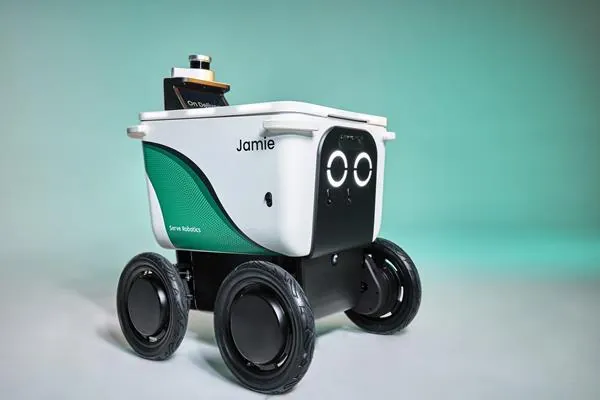
Serve has three generations: the Postmates Serve robot (December 2018), Gen 2 (commercial "Level 4" deliveries from January 2022) and Gen 3 (October 2024), which doubled speed and range at half the manufacturing cost; more than 2,000 were deployed by December 2025. Serve does not list a Gen 4; a third-party catalog entry for one cites no company source.
Delivery capacity
Large, several pizzas or a large grocery order
Up to 50 lb/22.7 kg in a 15 gal/56.8 L bin, or 'four large pizzas with drinks and sides.'
Wheeled robotIn serviceAnnounced October 16, 2024 · December 2024 – now
Serve's current robot, unveiled October 16, 2024: about twice Gen 2's speed and range and five times its computing power, at half the manufacturing cost.
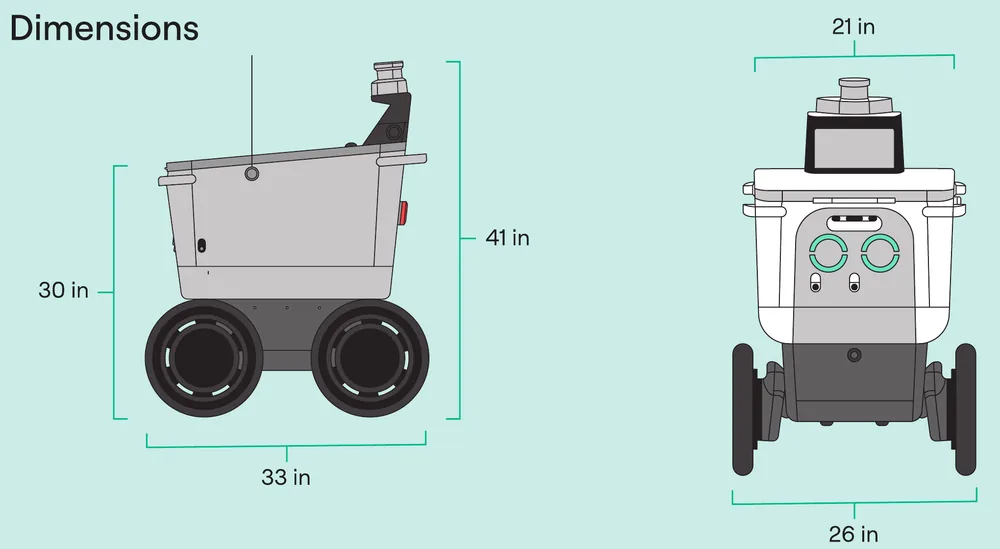
33 × 26 in (84 × 66 cm) long and wide; 41 in (104 cm) tall to the top of the LiDAR, 30 in (76 cm) to the lid [5]
Sensors
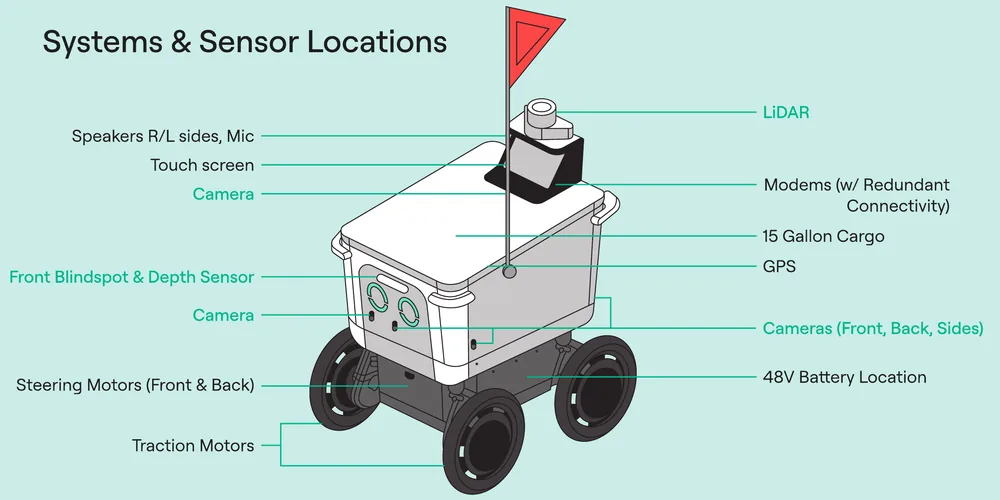
Ouster REV7 360° LiDAR on a mast, stereo cameras and 5 cameras around the chassis, a front blind-spot and depth sensor, and ultrasonic sensors [1][3][4][5]
Compute
NVIDIA Jetson Orin, five times Gen 2's computing power [1][4]
Wheels
Four wheels with all-terrain tires on a new drivetrain with suspension [2][3]
Battery and range
48 mi (77 km), about 14 hours; 67% more battery capacity than Gen 2 [2][3]
Systems and sensor locations. Diagram: Serve Robotics [5].
Design points
Cost is an engineering target. Gen 3 runs "5 times more AI" at half Gen 2's manufacturing cost and is assembled by contract manufacturer Magna, which CEO Ali Kashani said "puts Serve significantly down the cost curve". [1][2]
More hours in the field. A 67% larger battery gives "6 more hours per day in the field" (about 14 hours instead of 10), so each robot can make more deliveries a day. [1][2][3]
Suspension protects the food. Gen 3's drivetrain added suspension to drive smoother and faster while protecting food quality. [1][3]
Serve Gen 2
Wheeled robotRetiredAnnounced January 13, 2022 · January 2022 – 2025
Serve's first robot to deliver commercially without a human chaperone ("Level 4" within defined areas, from January 2022), with an Ouster LiDAR and NVIDIA Jetson computing.
Payload, empty weight, dimensions, wheels, and manufacturing
Design points
Redundancy for Level 4. Gen 2 has "multiple layers of redundant systems for critical navigation functions" across LiDAR, ultrasonic sensors and cameras, plus a fail-safe mechanical brake. [6]
Postmates Serve (Gen 1)
Wheeled robotRetiredAnnounced December 13, 2018 · December 2018 – 2022
Postmates' own delivery robot, unveiled December 13, 2018: a bright yellow, Wall-E-like design with a Velodyne LiDAR, a touchscreen for video chat and a light ring that signals turns.
Cargo space, empty weight, dimensions, compute, wheels, and manufacturing
Design points
Make the robot approachable. Big eyes, a bright yellow body and a video-chat screen invite people to interact with it. Serve has not described this as a lesson; it is our observation from the design. [7]
Milestones
January 13, 2022 Gen 2 robots begin commercial deliveries without a human chaperone, described as "Level 4" within defined areas [6]
December 2024 First 75 third-generation robots delivered from Magna's production line [8]
December 12, 2025 More than 2,000 robots deployed, Serve's 2025 goal [9]
November 5, 2026 Serve Physical AI Services launched: the technology behind Serve's fleets offered to other robot makers [10]
Sources
10
Each source lists what on this page it supports. See the methodology for how sources are classified.
Pictures belong to those credited under them and are shown to identify and compare the vehicles; they are not covered by the data license.
Images: Serve Gen 3Vehicles: Serve Gen 3 (cargo space; sensors; compute; manufacturing)Design points: Serve Gen 3 (Cost is an engineering target; More hours in the field; Suspension protects the food)
“5x more on-board computing power … Manufacturing cost halved”
The robot photos are the release's attached images ("Source: Serve Robotics Inc.").
Vehicles: Serve Gen 3 (cargo space; wheels; battery and range; top speed; manufacturing); Serve Gen 2 (cargo space; battery and range; top speed)Design points: Serve Gen 3 (Cost is an engineering target; More hours in the field)
“faster, smarter, tougher, and a fraction of the cost to manufacture”
The Gen 2 figures (13 gal, four 14-inch pizzas, 32 to 104°F) and both robots' front views come from the Serve Robotics graphic embedded in the article.
Vehicles: Serve Gen 3 (cargo space; sensors; wheels; battery and range; top speed)Design points: Serve Gen 3 (More hours in the field; Suspension protects the food)
“They can reach up to 11 miles per hour (18 kilometers per hour) and travel as far as 48 miles (77 kilometers) on a single charge. They also feature an expanded 15 gallon (61 liter) cargo bin that holds four large 16-inch pizzas. Their new drivetrain is equipped with suspension … active sensors (such as LiDAR and ultrasonics) and passive sensors (such as cameras)”
Serve robot ↗, Serve Robotics, accessed November 2026 Official
Vehicles: Serve Gen 3 (cargo space; sensors; compute)
“Each robot holds up to four large pizzas plus drinks and sides in an insulated compartment … Our Gen3 robots have 5x more brain power with Nvidia Jetson Orin and Ouster REV7 Lidar … Tap in to unlock your order on our state-of-the-art touch screen interface.”
Vehicles: Serve Gen 3 (payload; empty weight; dimensions; sensors; top speed)Images: Serve Gen 3
“They weigh about 220 pounds unloaded and can carry up to 50 pounds in the cargo bin. … The sensor suite includes 360° LiDAR and stereo cameras, and 5 around-chassis cameras … Our delivery robot’s top speed is 11 mph as of March 6, 2026.”
Linked from Serve's May 19, 2026 blog post introducing the plan (serverobotics.com/blog/frip/). It describes the third-generation robot; the dimensions and sensor locations are its page 10 drawings.
Vehicles: Postmates Serve (Gen 1) (payload; sensors; battery and range; top speed)Design points: Postmates Serve (Gen 1) (Make the robot approachable)
“carry up to 50 pounds of goods and can travel up to 30 miles on a single charge … Serve uses Velodyne Lidar and cameras to help it navigate … moves alongside pedestrians at walking speed … a touchscreen for video chat … a light ring on top to provide turn signals”