Manna has flown one evolving in-house design: a deliberately heavy, quiet multirotor with large propellers, triple-redundant flight computers, a parachute and tether delivery. Its website now calls its aircraft Manna 2. Its US service began north of Fort Worth on October 31, 2023, and in 2026 it made Tulsa, Oklahoma its main US base.
Delivery capacity
Carrying capacity not recorded on the site yet.
Vehicles
Manna 2
DroneIn serviceOctober 2023 – now
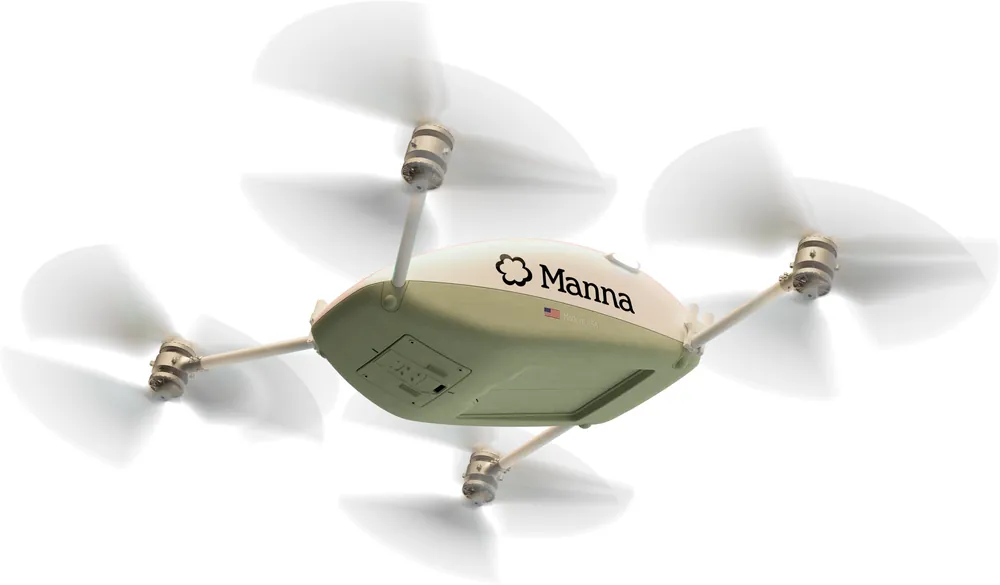
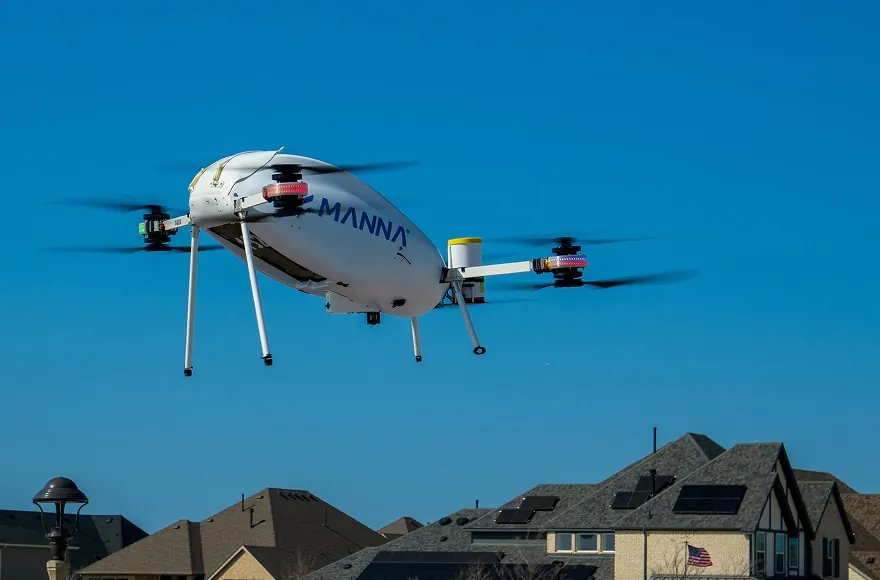
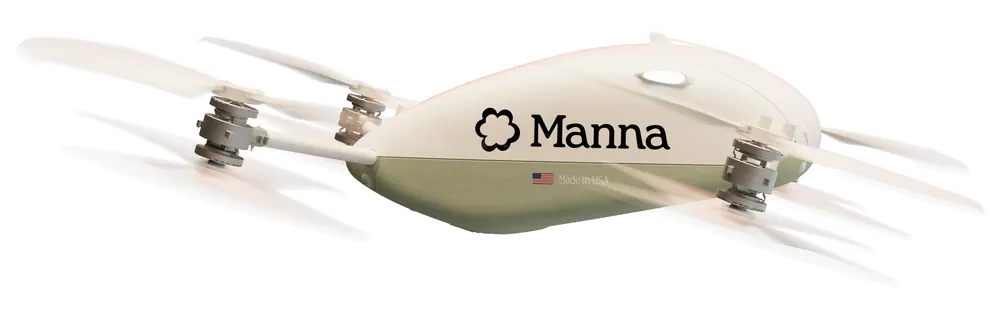
Manna's aircraft in service: four arms with stacked pairs of propellers, three flight computers and a parachute, lowering orders on a tether.
Triple-redundant sensors; a low-resolution camera takes one image of the drop zone just before delivery [2][4]
Compute
Three flight computers that cross-check every command [1][2][3]
Propulsion
Four arms, each with a stacked (coaxial) pair of propellers: "eight motor pods" in Manna's February 2026 post, "four independent motors" on its technology page; keeps flying if one fails, with a parachute as the backup [1][2][3]
Delivery
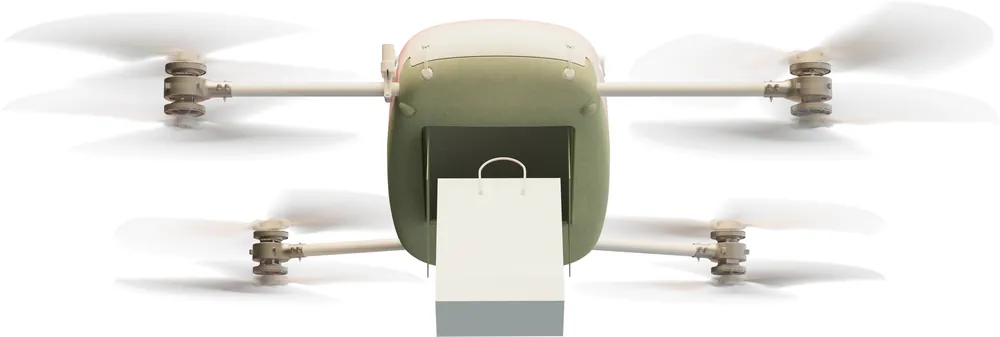
Descends to about 50 ft (15 m) and lowers the order on a biodegradable tether; it never lands [1][5][6][7]
Lowering an order. Render: Manna [1]. Labels added by Delivery Tech Watch from [1]. Labeled: Payload bay.
Side view, with labels where Manna's page places them. Render: Manna [1]. Labels added by Delivery Tech Watch from [1]. Labeled: 3 flight computers and Motor pod.
Design points
Noise decides public acceptance. CEO Bobby Healy says noise matters to the public more than anything: small propellers make sounds "the human brain subjectively considers not nice". Hence large propellers and, later, coaxial pairs tuned to cancel certain frequencies. [3][9]
Fast turnaround is a design goal. Hot-swap batteries and under-60-second turnarounds support eight deliveries per hour per aircraft. [3]
A camera that only checks the drop zone. The aircraft records no video in flight. A low-resolution camera takes one image just before the drop to check the spot is clear, and the image is then deleted. [4]
Manna octocopter (as described in 2021)
DroneRetired2019 – 2023
Manna's European aircraft as described in April 2021: a deliberately heavy multirotor with 30-inch propellers on oval carbon-fiber arms.
Manna octocopter (as described in 2021) specifications
Three independent systems, each with its own flight computer, GPS and compass [9]
Propulsion
30-inch propellers on oval carbon-fiber arms; a parachute deploys if two motors on the same arm fail [9]
Range
3 to 4 mi (5 to 6 km) radius; an auxiliary battery gives 120 seconds of flight if the main one fails [9]
Manufacturing
"We design, develop, and manufacture the aircraft ourselves." [9]
Unknown
Empty weight, dimensions, sensors, delivery, and top speed
Design points
Heavy on purpose. "Our aircraft is designed to be very heavy", trading efficiency for redundancy and stability in wind. [9]
Know your single point of failure. Everything is tripled except propulsion: "We're fine if we lose a motor or even two. But if we lose two on the same arm, you have a big problem", which is exactly when the parachute fires. [9]
Milestones
2021 First drone delivery company in Europe to receive a Light UAS Operator Certificate, from the Irish Aviation Authority [10][11]
October 31, 2023 First US deliveries, from the AllianceTexas Mobility Innovation Zone, Fort Worth, to Pecan Square in Northlake, Texas [5]
April 2026 Up to 40 new US bases planned after a $50M raise; operates in Europe under an EASA Light UAS Operator Certificate [6]
June 2026 SAIL III Operational Authorisation from the UK Civil Aviation Authority, one of the first for a drone delivery company [10][11]
July 2026 Tulsa, Oklahoma chosen as the main US base, with a local factory under construction [12]
August 12, 2026 First US base opens on Cherry Street in Tulsa, Oklahoma, with three aircraft; consumer deliveries begin [13]
October 13, 2026 First batch of US-built aircraft in production, as Manna adds three more Tulsa bases [14]
Sources
14
Each source lists what on this page it supports. See the methodology for how sources are classified.
Pictures belong to those credited under them and are shown to identify and compare the vehicles; they are not covered by the data license.
Images: Manna 2Vehicles: Manna 2 (cargo space; compute; propulsion; delivery; range)Image labels: Manna 2
“Four independent motors share the work. … Speed Up to 50 mph … Delivery Radius Up to 2.5 miles”
The figures appear in pop-ups loaded by script; read by rendering the page. The pop-ups open from markers placed on the side render (flight computers, propulsion, the order).
Vehicles: Manna 2 (payload; sensors; compute; propulsion; top speed)
“Triple-redundant safety systems with three flight control computers and sensors … Eight motor pods providing backup propulsion. … Airline-grade parachute systems … cruise at speeds up to 50 mph … a payload capacity of up to 8.8 lb per delivery … coaxial propulsion systems that cancel certain frequencies … at typical flight altitudes of 200 feet”
Design points: Manna 2 (Noise decides public acceptance); Manna octocopter (as described in 2021) (Heavy on purpose; Know your single point of failure)Vehicles: Manna octocopter (as described in 2021) (cargo space; payload; compute; propulsion; range; manufacturing)
“We design, develop, and manufacture the aircraft ourselves. … Our aircraft is designed to be very heavy.”