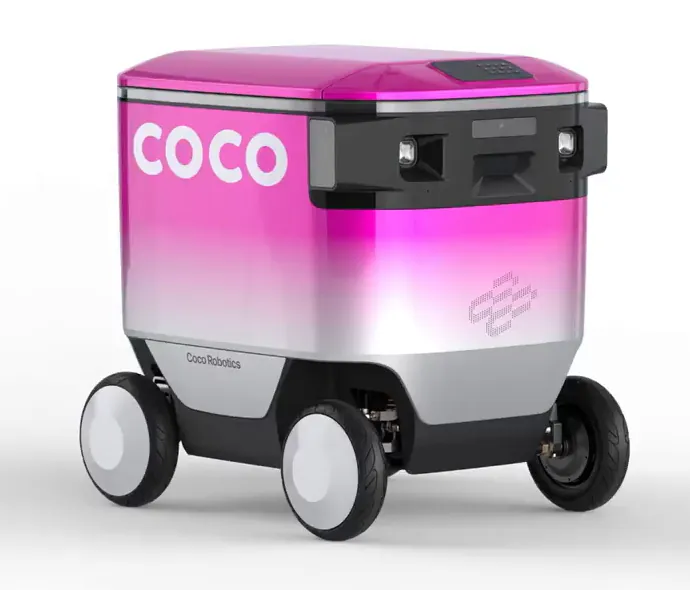
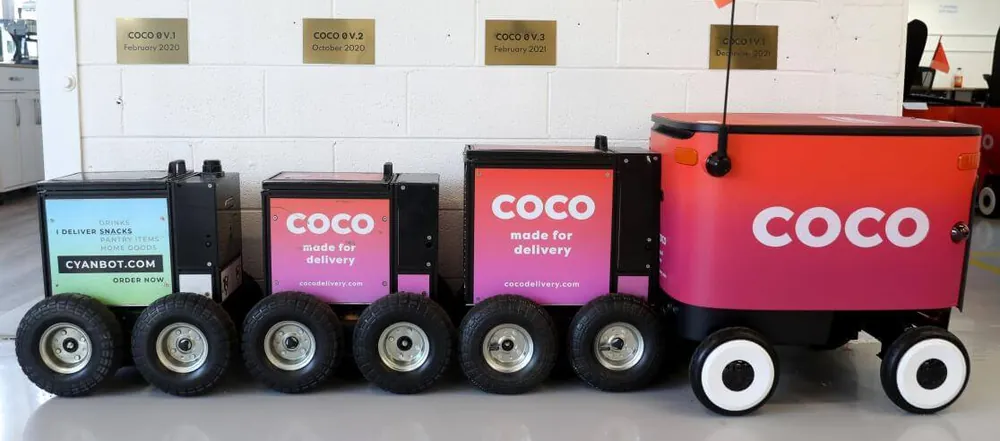
Coco has had three generations: remotely piloted pink robots from 2020, the larger COCO 1 built with Segway (December 2021), and the road-capable, largely autonomous COCO 2 with solid-state LiDAR (February 2026). Its stated design principle has been reliability first.
Delivery capacity
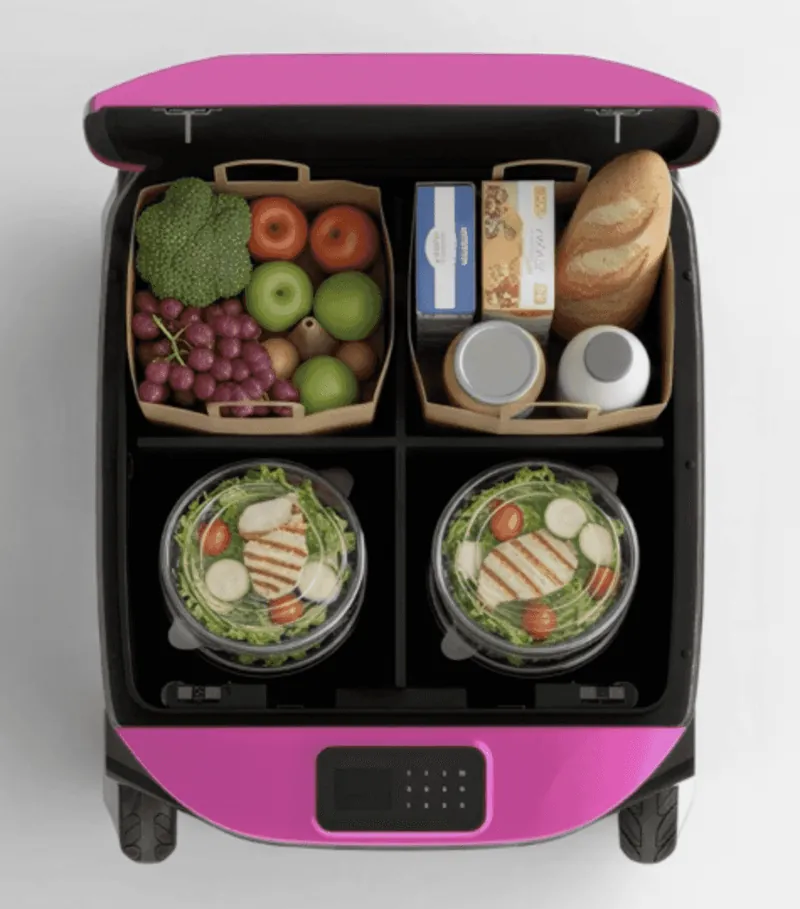
Large, several pizzas or a large grocery order
Up to 23.8 gal/90 L in the COCO 1 model. The COCO 2 model has a larger cargo area ('one 4x18 pizza').
Wheeled robotIn serviceAnnounced February 26, 2026 · 2026 – now
Coco's current robot, unveiled February 2026: the first Coco built to drive itself rather than be remotely piloted, and to leave the sidewalk for bike lanes and roads where permitted.
Four wheels; turns in place; quick-swap tires, including snow tires; climbs 30% grades [1][3][5]
Battery and range
Swappable; 20 mi (32 km) range; designed for deliveries within about 2 mi [1][3]
Top speed
13 mph (21 km/h) on roads and bike lanes where permitted; slower on sidewalks [1][2]
Unknown
Payload, empty weight, dimensions, and manufacturing
Cargo bay. Render: Coco Robotics [1]. Labels added by Delivery Tech Watch from [1][2]. Labeled: Fits four 18 in pizzas; up to 6 compartments.
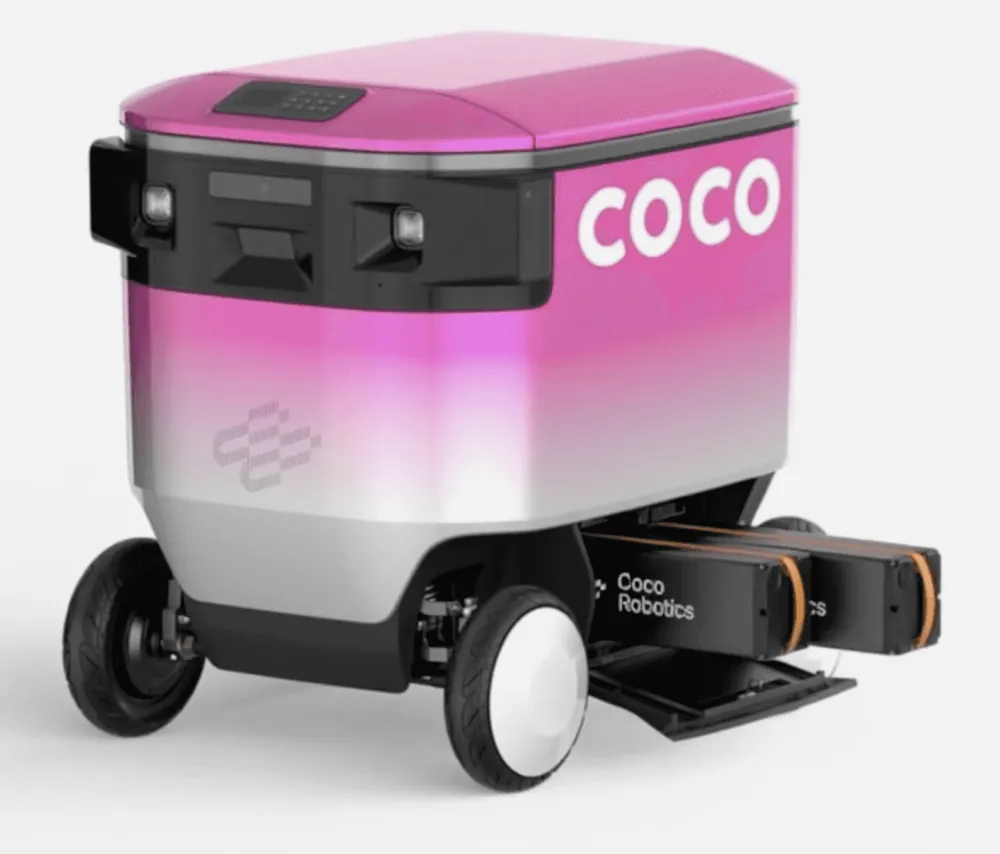
Battery swap. Render: Coco Robotics [1]. Labels added by Delivery Tech Watch from [1]. Labeled: Swappable batteries.
Design points
Leave the sidewalk to go faster. Coco 2 is built to use bike lanes and roads at up to 13 mph where permitted, which Coco says cuts delivery times by up to half. The robots are routed toward the best infrastructure and lowest traffic. [2][4]
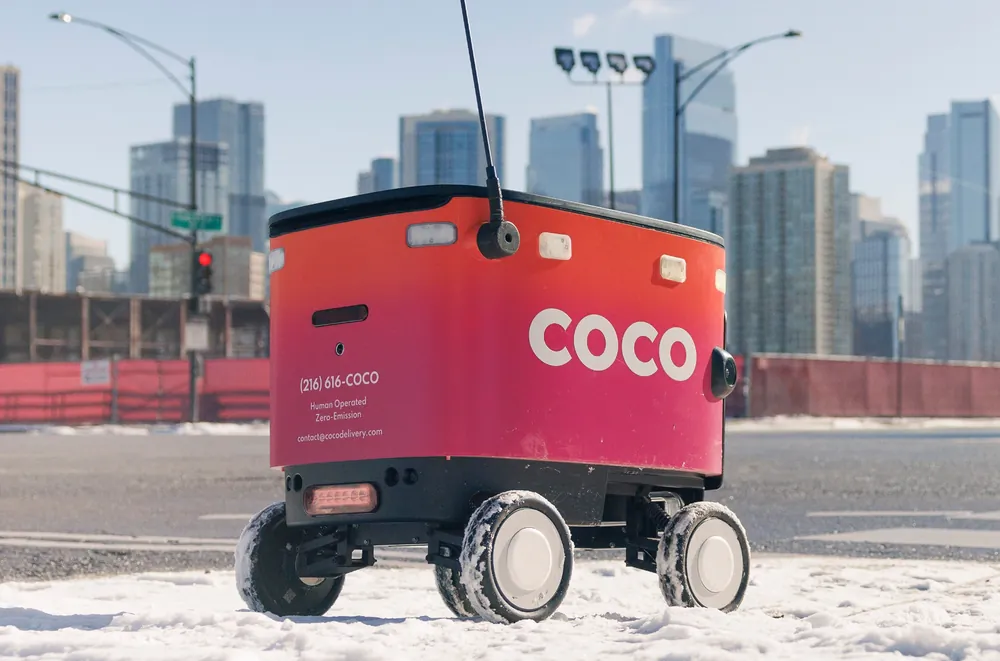
Built for floods, snow and rain. Flooded Miami streets and Chicago snow led to a submersible body, snow tires and an air blade that clears water from the sensors. [3][4][5]
Swap parts instead of waiting. Batteries and tires swap quickly in the field. Coco says reliability "is everything" and claims up to three times the uptime of the prior generation. [1][3][4][6]
COCO 1
Wheeled robotIn serviceAnnounced December 2, 2021 · December 2021 – now
Coco's second robot, built with Segway on its RMP base and launched in December 2021: larger, with nearly double the original's range, and still remotely piloted.
Payload, empty weight, dimensions, compute, and top speed
Design points
Merchant feedback drives hardware. Coco "applied merchant feedback to increase carrying capacity", then added cup holders and insulation. Building on Segway's existing platform rather than a custom drivetrain gave faster, more stable driving and nearly double the range. [6][8]
Original Coco robot (Cyan Robotics)
Wheeled robotRetired2020 – 2021
Coco's first robots, remotely piloted sidewalk boxes launched in Santa Monica in April 2020, built in three versions ("Coco 0" v1 to v3) before the COCO 1.
Coco 0 v1 to v3 and the COCO 1, dated by their plaques. Photo: Coco Robotics [9]. Labels added by Delivery Tech Watch from [9]. Labeled: v1 Feb 2020, v2 Oct 2020, v3 Feb 2021, and COCO 1 Dec 2021.
Original Coco robot (Cyan Robotics) specifications
Battery and range
About half the COCO 1's 3 mi (4.8 km) delivery radius [8]
Unknown
Cargo space, payload, empty weight, dimensions, sensors, compute, wheels, top speed, and manufacturing
Design points
Ship with humans in the loop. Coco started with remotely piloted robots instead of waiting for autonomy; operators handled "any complicated scenarios, which happens all the time". Coco says those human-in-the-loop lessons trained the later, autonomous fleet. [4][6]
Sources
9
Each source lists what on this page it supports. See the methodology for how sources are classified.
Pictures belong to those credited under them and are shown to identify and compare the vehicles; they are not covered by the data license.
Vehicles: COCO 2 (cargo space; sensors; wheels; battery and range)Design points: COCO 2 (Built for floods, snow and rain; Swap parts instead of waiting)
“We want these robots to be operating most of the time. … The Coco 2 is designed for a roughly two-mile delivery range”
Vehicles: COCO 2 (compute)Design points: COCO 2 (Leave the sidewalk to go faster; Built for floods, snow and rain; Swap parts instead of waiting); Original Coco robot (Cyan Robotics) (Ship with humans in the loop)
Design points: COCO 2 (Swap parts instead of waiting); COCO 1 (Merchant feedback drives hardware); Original Coco robot (Cyan Robotics) (Ship with humans in the loop)Vehicles: COCO 1 (cargo space)
“This is a business where reliability is everything.”
Vehicles: COCO 1 (cargo space; sensors; wheels; battery and range; manufacturing); Original Coco robot (Cyan Robotics) (battery and range)Design points: COCO 1 (Merchant feedback drives hardware)
“nearly double the range of the original model”
About Coco ↗, Coco Robotics, accessed November 2026 Official
Images: Original Coco robot (Cyan Robotics)Image labels: Original Coco robot (Cyan Robotics)
“What began as a simple idea in a college dorm room has quickly grown into a global operation.”
The version names and dates come from the plaques in a photo on the page: COCO 0 V.1 February 2020, V.2 October 2020, V.3 February 2021, COCO 1 V.1 December 2021.
Seen a specification or a model we're missing? Reach out.