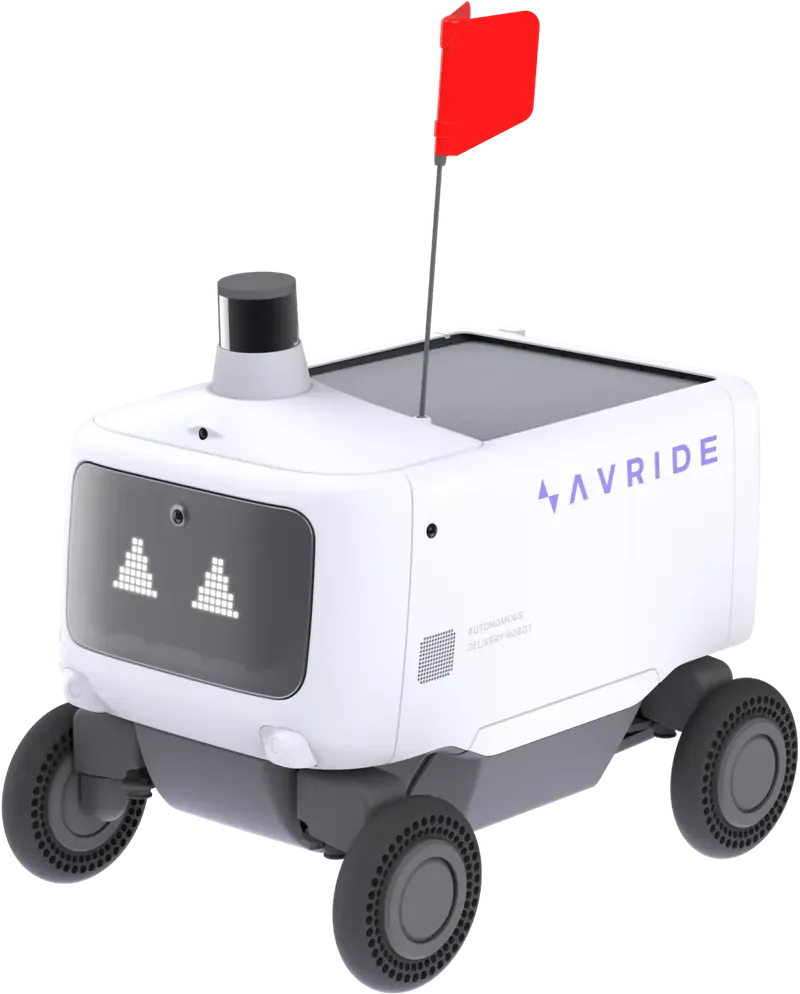
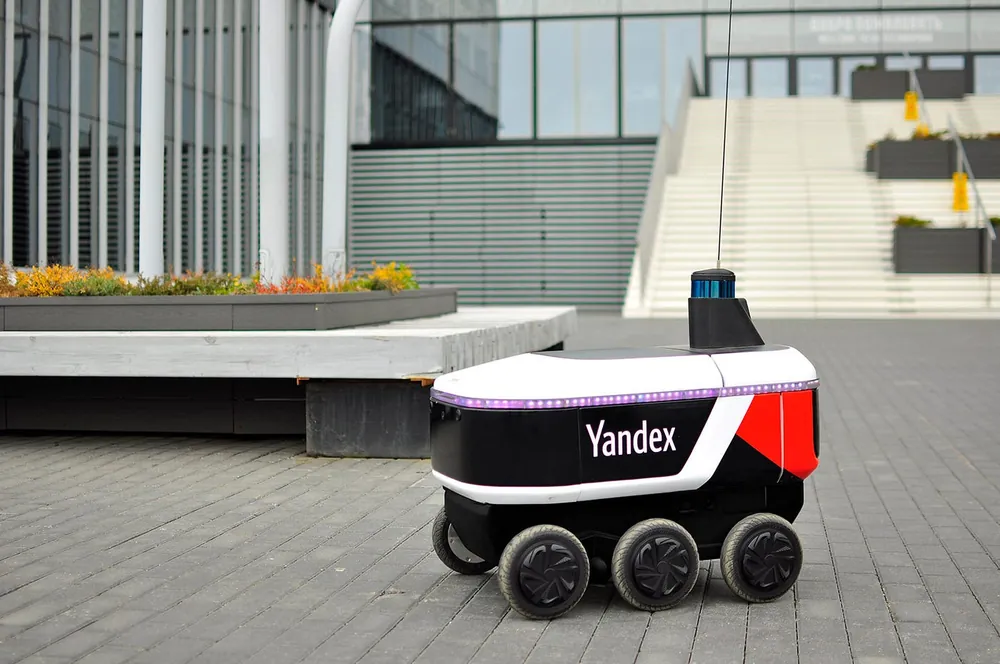
Avride had four six-wheeled generations (R1, R1.5, R2, R3) built as Yandex.Rover from 2019 to 2021, then a four-wheeled redesign with an LED face announced October 30, 2024. The international division became Avride in August 2023 and stayed with Nebius Group when Yandex sold its Russian businesses in July 2024.
Delivery capacity
Large, several pizzas or a large grocery order
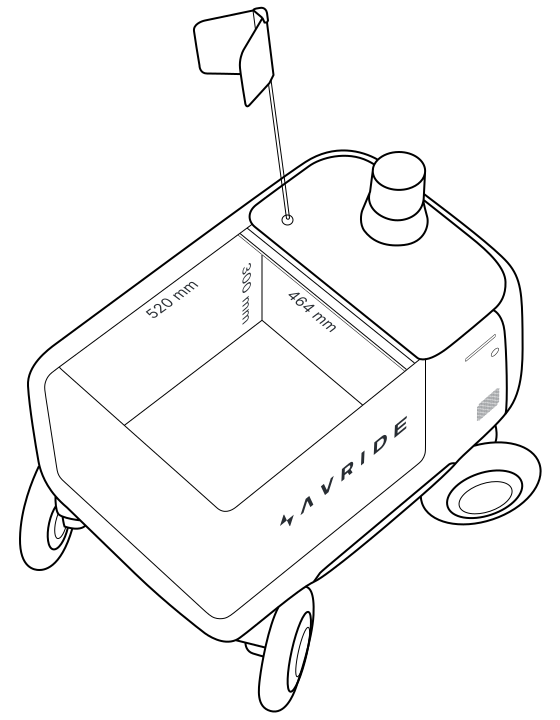
Up to 55 lb/25 kg with max dimensions of 20.4 in (520 mm) x 18.2 in (464 mm) x 11.8 in (300 mm).
Mass-produced, with some components, such as LiDARs, sourced from specialized external vendors [6]
Unknown
Empty weight
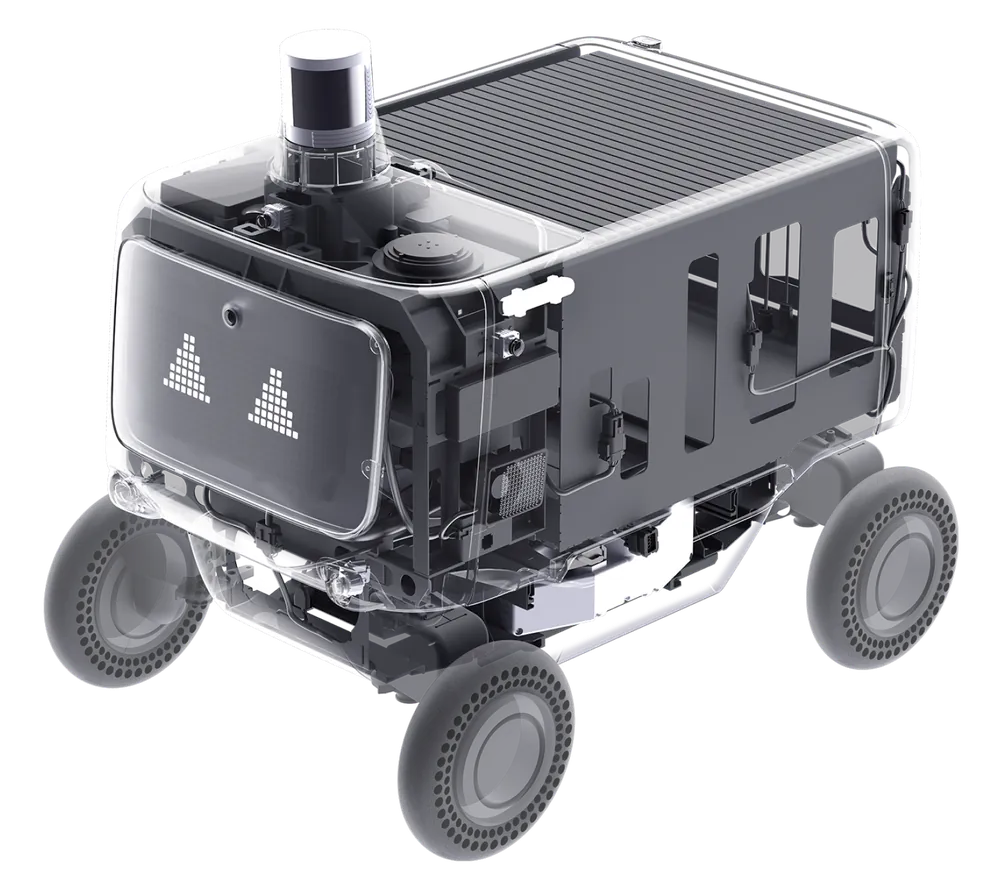
Sensors. Render: Avride [1]. Labels added by Delivery Tech Watch from [1]. Labeled: LiDAR, 6 cameras, and 4 ultrasonic sensors.
Cargo box. Diagram: Avride [1]. Labels added by Delivery Tech Watch from [1]. Labeled: Cargo box 20.4 × 18.2 × 11.8 in (520 × 464 × 300 mm).
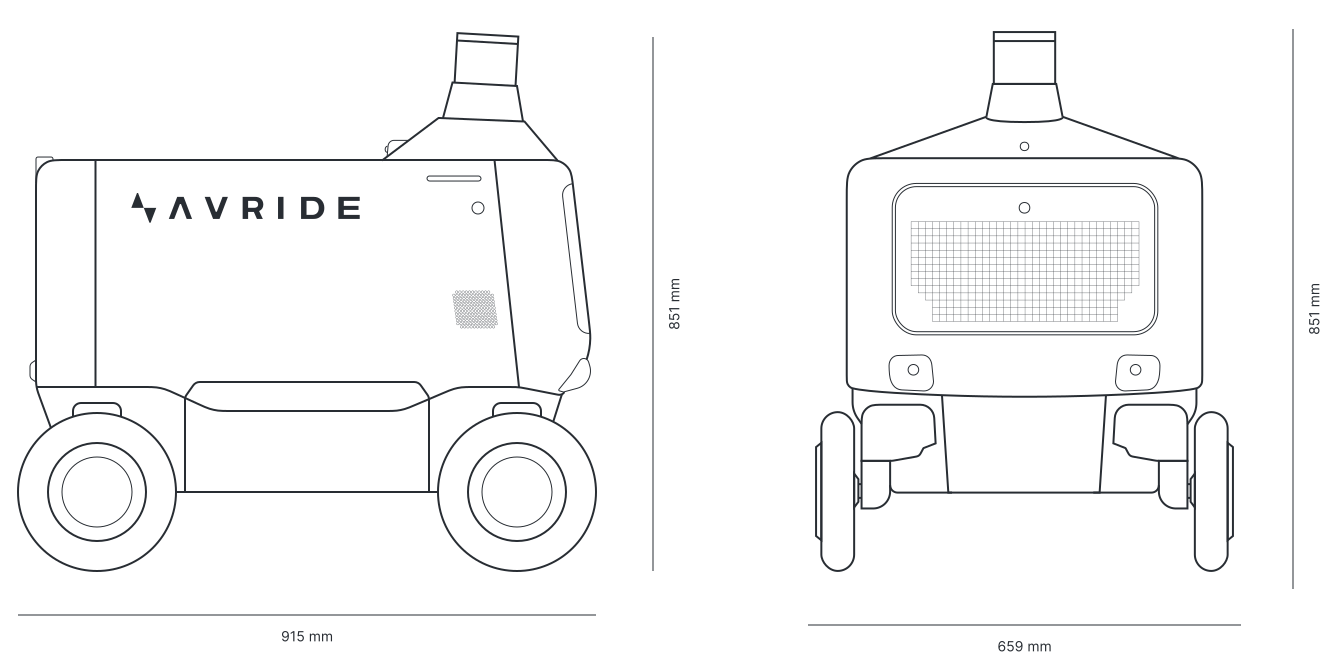
Side and front. Diagram: Avride [1]. Labels added by Delivery Tech Watch from [1]. Labeled: 36 in (915 mm), 33.5 in (851 mm), 25.9 in (659 mm), and 33.5 in (851 mm).
Design points
Why six wheels became four. The six-wheel layout was simple and stable but with no steered wheels, the robot turned by braking the wheels on one side against the other. The increased friction wears tires and uses "almost 3 times" the energy of straight driving. The four-wheel chassis accepts harder control software to gain efficiency, precision, and a 180-degree turn for backing out of narrow sidewalks. [2][5]
Redundancy keeps robots moving. If a drive motor fails, "the remaining three drive motors will provide enough power to keep the robot moving". Torque alone can also reposition the wheels. [2]
R3 (Yandex.Rover, 4th generation)
Wheeled robotIn service2021 – now
The last six-wheel generation. Moving the LiDAR to the front forced an entirely new structure, and the one-piece body and aluminum frame were dropped to simplify manufacturing and repair.
Designed in-house, with parts made and assembled by contractors; a fiberglass body on a pan-and-frame base [7]
Unknown
Compute
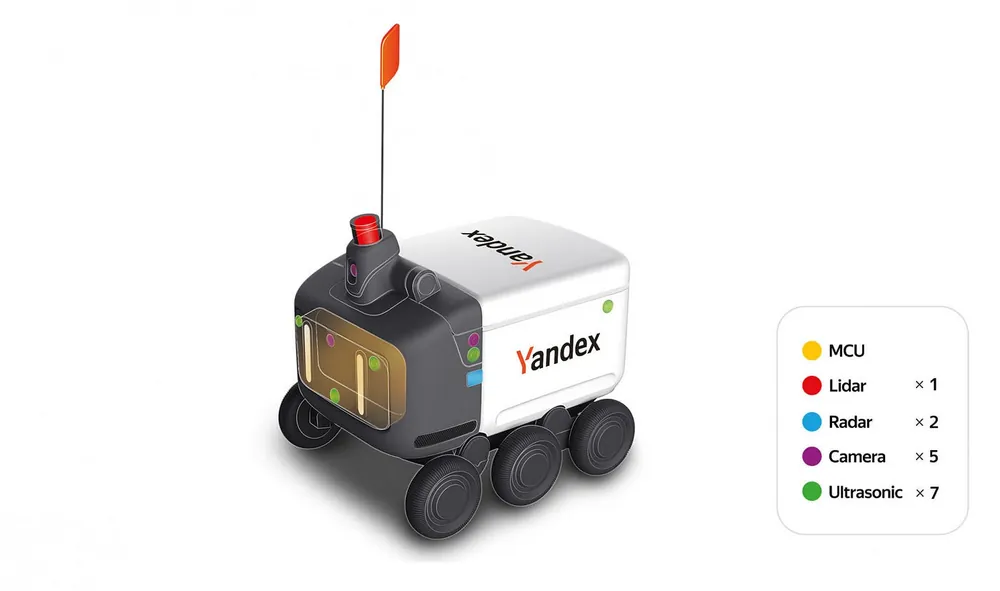
Sensors; the legend counts those seen from this side (the text gives 9 ultrasonic sensors and a sixth, telephoto camera). Diagram: Yandex Self-Driving Group [7].
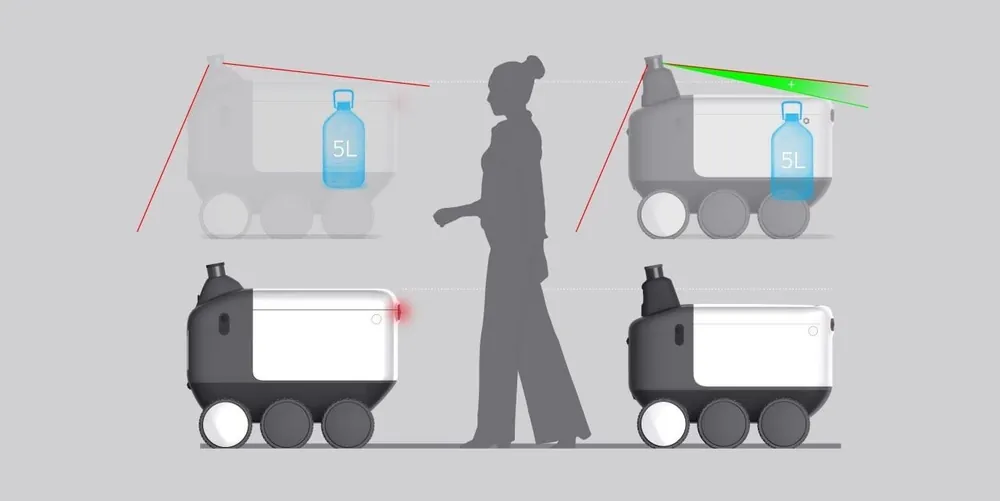
Balancing storage size and the LiDAR's viewing angle: a rear LiDAR (left) leaves a blind zone in front that a front one (right) covers. Diagram: Yandex Self-Driving Group [7].
R2 (Yandex.Rover, 3rd generation)
Wheeled robotRetired2020 – 2021
The first generation designed for commercial service: about 100 were built and used in every location, including the US.
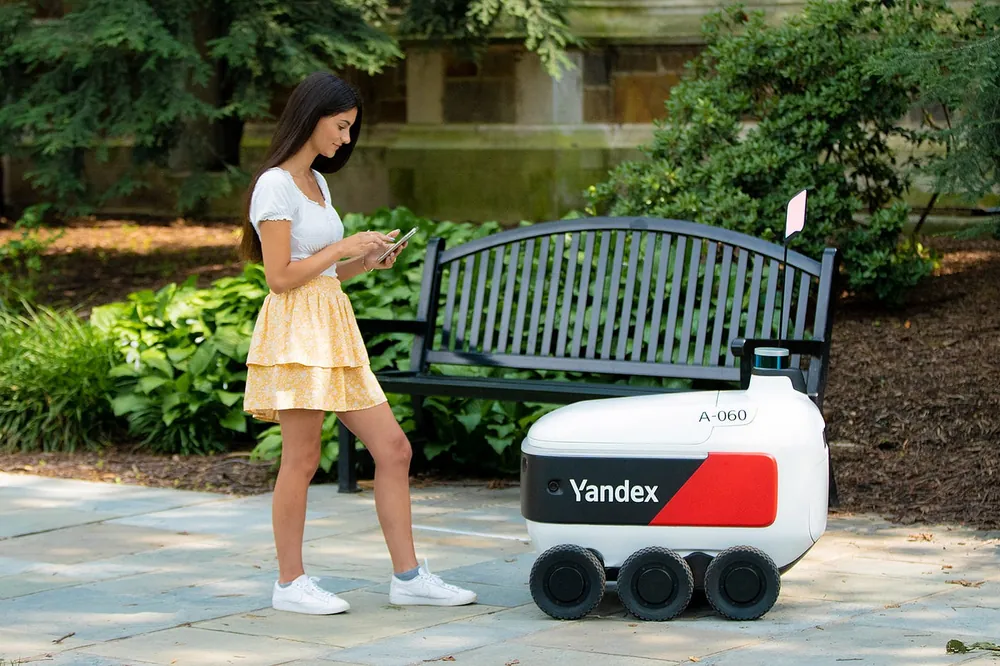
Delivering an order in Ann Arbor, Michigan. Photo: Yandex Self-Driving Group [7].
About 100 built, on a welded aluminum frame with a one-piece body [7]
Unknown
Payload, empty weight, dimensions, and top speed
Design points
Prototype fast with bought parts, then make your own. R1 used off-the-shelf parts to test quickly whether car self-driving software could run a delivery robot. By R2 the cameras and ultrasonic sensors were in-house, so engineers could see raw data and tune them instead of trusting a "black box". [7]
Supplier risk forced new wheels. The gyro-scooter wheels were discontinued, and belt-driven motors inside the body overheated and lacked torque, so R2 moved to motorized wheels from a new supplier. [7]
R1.5 (Yandex.Rover, 2nd generation)
Wheeled robotRetired2020 – 2021
The R1 rebuilt around an ARM computer (the power-efficient processor design used in phones), which doubled its runtime.
“Speed Range 8 km/h (5 mph) 50 km (31 mi) on one charge … Max Cargo Weight … 25 kg (55 lb) … Length Width Height Height with flag 915 mm (36 in) 659 mm (25.9 in) 851 mm (33.5 in) 1298 mm (51.1 in) … even on a single battery I can work for up to 12 hours and even longer”
The page's renders highlight each sensor (LiDAR, cameras, ultrasonic), facing every side of the robot, and its drawings give the overall and cargo dimensions; the sensor counts are counted from the renders.
“At Avride, our robots are mass-produced on a factory floor. To date, we’ve assembled almost 1000 robots on this particular assembly line. The factory can produce up to 100 ready-to-go robots per month”